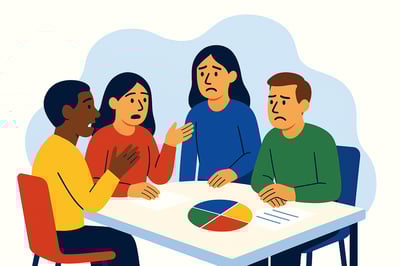
Every leader wants collaboration that flows. But too often, it feels like a tug-of-war between brainstormers chasing ideas while process-driven teammates ask for the plan. Both mean well. Both are strong. And both are exhausted.
That’s not dysfunction. That’s behavioral friction and happens when natural strengths collide instead of complementing each other.
It’s not about personality. It’s about wiring.
Every person brings a Preferred Mode (the way they work best) to the situation. When those modes misalign, collaboration turns into competition.
👉 Friction draining your team’s momentum? Align roles by our Job Fit Solution →
The Hidden Cost of Collaboration
Most teams don’t struggle because of lack of effort. They struggle because people are contributing from different gears.
- The brainstormers (Yellows and Blues) thrive on ideas, dialogue, and flexibility.
- The implementers (Reds and Greens) thrive on clarity, structure, and action.
Both are essential. But when one group feels the other is slowing them down, or skipping steps, tension builds.
Case Study
A marketing team sets out to launch a new campaign.
- The creative group floods the board with possibilities.
- The operations team insists on deadlines and process.
By week three, collaboration has stalled. The creatives feel “micromanaged.” The ops team feels “ignored.”
Neither is wrong, they’re just wired differently.
Once you see that, you stop blaming behavior. You start aligning it.
How Behavior Shapes Collaboration
Preferred Mode drives how people contribute when energy is high. When everyone operates in their Preferred zone, work feels natural and sustainable.
When they’re forced out of it, stress builds and productivity drops.
Here’s how each color’s collaboration energy shows up:
Green (Structure): Builds order, defines process, protects quality.
Red (Urgency): Creates momentum, drives decisions, delivers outcomes.
Yellow (People): Energizes the group, promotes optimism, keeps engagement high.
Blue (Ideas): Brings creativity, explores alternatives, challenges assumptions.
Now imagine three Reds and one Green on a task: decisions fly, but details get missed. Or three Greens and one Red: plans are perfect, but deadlines slip. Too much similarity creates drag. Balance creates flow.
What Collaboration Friction Looks Like
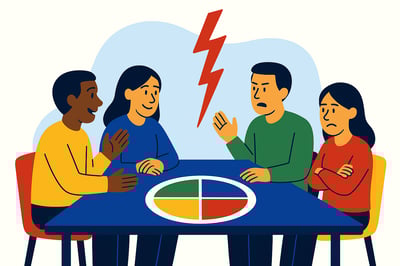
Meetings filled with talkers and doers talking past each other.
Projects are delayed because no one agrees on what “done” looks like.
High performers quietly withdraw not from the mission, but from the mode of collaboration.
Team energy dipping after each brainstorm or review cycle.
These are all signs that wiring, not willpower, is driving the disconnect.
👉 Curious what’s really behind your team’s friction?
From Collision to Complement
Behavioral diversity is your greatest advantage once it’s visible. Here’s how to convert tension into traction:
- Map Preferred Modes Before Assigning Roles
Before you delegate, ask: Who thrives on ideas? Who thrives on structure? Who pushes for pace? Match roles to natural energy, not job titles.
- Pair Opposites Intentionally
Balance every visionary (Blue) with an organizer (Green). Balance every driver (Red) with a harmonizer (Yellow). It’s not about comfort, it’s about complement.
- Make Behavioral Language Normal
Normalize quick check-ins like: “I’m going to switch to my Green mode here for a minute.” It reminds everyone that behavior is dynamic, not personal.
- Protect the Recovery Cycle
After high-energy collaboration, Greens and Blues need processing time. Reds and Yellows need action or feedback. Pace recovery based on what each color needs to recharge.
Reflection: Seeing the Pattern Beneath the Pushback
Friction isn’t failure. It’s feedback. Ask yourself:
- Who on your team naturally speeds up and who steadies the pace?
- Where do strengths double up instead of balance out?
- Which conversations leave you thinking, “We’re saying the same thing differently”?
- What would happen if you treated collaboration friction as a wiring problem, not a people problem?
When you can see your team’s behavioral mix, you stop fighting the pattern and start designing with it.
See the Entire Collaboration System
This post showed one slice of team dynamics. Get the full behavioral playbook that helps teams communicate, plan, and recover in sync.
Get The Guide
Next Steps for Growth
For Individuals → Discover how your wiring shapes how you contribute and how to recharge after collaboration
For Teams → Map your team’s wiring to assign roles that fuel, not drain, momentum
For Consultants → Deliver workshops that turn tension into trust using the MyHardWired framework