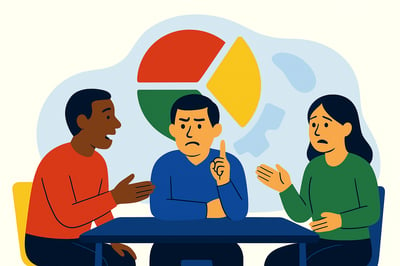
If you’ve ever sat in a meeting where Sales wants it now, Engineering wants it perfect, and Operations just wants it stable, you’ve seen cross-functional conflict in action.
It’s not personality. It’s wiring.
👉 Conflict across teams? Resolutions for cross-functional conflict are this easy
Why Cross-Functional Tension Is Predictable
Every function in your business attracts certain behaviors.
- Sales hires urgency and persuasion.
- Engineering hires precision and logic.
- Operations hires consistency and control.
Each function operates from a different behavioral mode and when those modes collide, tension sparks.
The good news? You can predict (and prevent) most of it once you know the four conflict archetypes.
The Four Conflict Archetypes (and Where They Show Up)
Every person and every department leans toward one of these instinctive patterns under stress.
The Rule Enforcer (Operations / Finance / Compliance)
Signals: “Where’s the process?” “We can’t skip steps.” “Show me the data.”
Strength: Protects quality and reliability.
Escalates when: Rushed, surprised, or contradicted without evidence.
Needs: Predictability, documented process, clear boundaries.
Leader micro-script: “You own the control points. Let’s document A→B→C so it’s repeatable.”
The Urgency Driver (Sales / Executives)
Signals: “We’re losing time.” “We need a decision.” “Let’s move.”
Strength: Creates movement, keeps momentum alive.
Escalates when: Others stall, overanalyze, or block progress.
Needs: Clarity, autonomy, and short-term wins.
Leader micro-script: “We’ll move this week. You own the next step, but let’s validate the process tomorrow.”
The Harmonizer (HR / Marketing / Customer Success)
Signals: “Let’s keep everyone on board.” “We can’t afford friction.”
Strength: Sustains morale, keeps relationships intact.
Escalates when: Tone turns negative or inclusion drops.
Needs: Appreciation, inclusion, tone safety.
Leader micro-script: “You’re right. The tone matters. You handle the rollout to keep the group aligned.”
The Challenger (Engineering / Strategy / R&D)
Signals: “What’s the rationale?” “Show me the logic.” “What are we missing?”
Strength: Pressure-tests ideas, avoids costly blind spots.
Escalates when: Questions are dismissed or decisions feel rushed.
Needs: Space to explore alternatives and clarity on “why.”
Leader micro-script: “We’ll decide in ten minutes. Give me two biggest risks and one counterproposal.”
What Happens When These Archetypes Collide
A new product launch.
Sales (🔴) pushes to ship early.
Engineering (🔵) wants time to fix edge-case bugs.
Operations (🟢) insists on compliance checks before rollout.
Marketing (🟡) wants a coordinated announcement to protect morale.
Everyone’s right from their behavioral lens.
But because no one’s translating the differences, conflict feels personal instead of predictable.
Without translation:
- 🔴 Reds see 🔵 Blues as blockers.
- 🟡 Yellows see 🟢 Greens as rigid.
- 🔵 Blues see 🟡 Yellows as superficial.
- 🟢 Greens see 🔴 Reds as reckless.
Translating Conflict Before It Escalates
Cross-functional conflict isn’t a communication failure.
It’s a translation failure.
Here’s how to decode it in real time:
- Read the Signals. What behavior is surfacing? Urgency? Positivity? Analysis? Control?
Name it out loud: “This sounds like a speed vs. detail tension.”
- Reframe Intent. Translate behavior into value: “You’re pushing for speed because you see opportunity.” “You’re slowing down because you’re protecting quality.”
- Route the Energy. Design a plan that honors both instincts: “We’ll launch a limited pilot (Red), with documented safeguards (Green).”
When Leaders See the Wiring, They Stop Guessing
Once you understand the archetypes, you stop assuming motive. You stop labeling someone “difficult,” and start seeing their Instinctive Mode under pressure.
You begin managing energy, not emotion.
And instead of mediating endless cross-team battles, you start turning them into alignment conversations.
Decode the Clash Before It Drains You
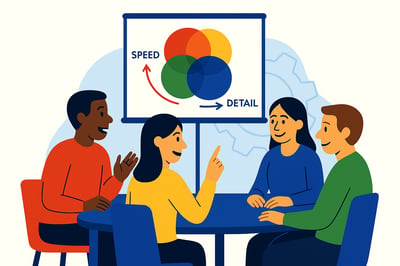
In your next cross-functional meeting, notice:
- Who pushes hardest for speed and who slows it down?
- Who protects tone and who protects logic?
- Who guards structure and who challenges assumptions?
Then ask yourself: “Which archetypes are in play and what do they each need to feel safe?”
Conflict won’t disappear. But when you see the wiring behind it, conflict stops being a battle and becomes a balance.
Check Out the Full Guide
You’ve learned the four conflict archetypes so now see how they show up in your own wiring.
Get The Guide
Next Step For Growth
For Individuals → Translate friction into feedback by understanding what every reaction is protecting
For Teams → Build rituals that balance urgency, logic, tone, and structure
For Consultants → Bring behavioral clarity to leadership teams who mistake wiring for attitude