The Consultant's Edge
The ROI Consultants Must Show (Even When Clients Don’t Ask)
Consulting isn’t safe anymore. Without metrics, you’re judged by feel. With behavior, you’re proven.
People believe what you prove. The science behind behavior builds that trust.
People believe what you prove. That is why the most effective consultants do not just sound credible. They can demonstrate it.
In a crowded consulting market, clients are skeptical of anything labeled insightful. They have seen every assessment and every color coded quadrant.
The question they ask now is not whether it is interesting. The question is whether it is proven.
That is where behavioral science changes everything. It is also where the MyHardWired model stands apart.
👉 Want credibility that earns trust. Share the science behind what you do
Most popular frameworks were built for reflection rather than prediction. They describe personality but do not explain behavior under pressure.
They rarely scale beyond the workshop room. Clients notice. Tools like DISC, MBTI, Enneagram, and Predictive Index each add value.
Yet none connect why people behave as they do across changing environments, rising stress, and shifting expectations. The missing dimension is where science meets practice.
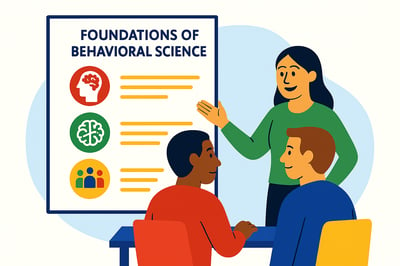
Behavioral science studies how people decide, learn, adapt, and act in context. It integrates three pillars.
Psychology. How thought patterns and emotion shape choice.
Neuroscience. How stress, reward, and safety influence attention and risk.
Social dynamics. How norms and expectations shape cooperation and trust.
The science shows that human behavior flexes with context. That is why MyHardWired was designed as a three dimensional behavioral map rather than a static label.
Most assessments define who someone is. MyHardWired defines how someone operates, adapts, and responds. The model measures behavior across three modes that align directly with established research.
Preferred Mode. Flow and intrinsic motivation. This explains the conditions that sustain high performance without burnout.
Expectations Mode. Social conditioning and reward systems. This reveals the learned rulebook that governs cooperation and tone.
Instinctive Mode. Threat response and cognitive bias. This predicts stress behavior, conflict patterns, and rapid recovery needs.
Explain behavior this way and soft skills stop looking soft. Leaders see human systems engineering that is precise, measurable, and repeatable.
Executives do not need every citation. They need clarity they can act on.
Link behavior to outcomes: Tie alignment to faster decisions, fewer reworks, and reduced turnover.
Speak in systems, not labels. Say we track how your team adapts under pressure rather than we assign types. Show the pattern. Use team maps and mode shifts so leaders can see and measure what is changing.
Highlight predictability: The difference between a theory and a science is replicability. When behavior becomes predictable, belief follows.
When clients ask what makes this credible, they are really asking five questions.
MyHardWired passes each test because it is built from behavior up rather than personality down.
Consultants win trust when they turn insight into predictable movement leaders can measure. This guide shows how to frame behavioral indicators that matter, set baselines quickly, and report momentum your clients can defend in the next budget cycle.
For Individuals → Learn how behavior science applies to your performance, focus, and decision making
For Teams → Build evidence based development programs grounded in measurable behavior
For Consultants → Deliver data backed insights with scientific precision through MyHardWired certification
Consulting isn’t safe anymore. Without metrics, you’re judged by feel. With behavior, you’re proven.
Learn why leadership skills often fade and how aligning them with your natural behavior can make them stick for lasting impact.
Different functions bring different behaviors. Understanding conflict styles saves collaboration.
Be the first to get new articles on Preferred Style, Expectations, and Instinctive Mode and practical ways to lead, coach, and hire in alignment with how people are actually wired.