The Consultant's Edge

Your Edge Toolkit: What Every Consultant Needs in Their Arsenal

Tools matter but only when they reflect behavior, not just trend.


A consultant stands in front of a group of leaders, presenting simple visual tools—checklist, diagram, and chart—on a whiteboard in a flat MyHardWired-style illustration. The group appears engaged and collaborative.

Consultants do not compete on charisma anymore. They compete on clarity.

Clients are not hiring you for ideas they can find online. They are hiring you for tools that reveal what they cannot see. Invisible patterns that drive how people work, lead, and react.

That is your differentiator. Your toolkit is how you prove it.

👉 Want a toolkit clients rave about. Build yours with ours in mind

Why Tools Define Credibility

Clients already assume you are smart. The real questions are simple.

  1. Can you measure what you teach?
  2. Can you show why this behavior happens?
  3. Can we use it after you leave?

Your answer must live in your toolkit, not your pitch deck. Without tangible, behavior based tools, your insight fades when the meeting ends.

With them, you create proof clients can hold in their hands.

What Belongs in a Consultant’s Edge Toolkit

A consultant stands with two colleagues in front of a presentation screen showing a four-quadrant MyHardWired gear in the correct color order—red top-left, yellow top-right, green bottom-left, blue bottom-right. One colleague gestures toward the gear as they discuss behavioral tools.

Every high performing consultant builds around three essentials. Insight. Evidence. Enablement.

  1. Insight tools. Make the invisible visible: Start with the MyHardWired assessment suite. It shows how clients operate across three Modes: 
    • Preferred Mode. Where people perform best.
    • Expectations Mode. How they have learned to gain cooperation.
    • Instinctive Mode. What drives reactions under stress.
    • Deliverables that work. Individual profiles, one to one comparison maps, and simple team snapshots. Once behavior is on paper, it becomes actionable rather than theoretical.
  2. Evidence tools: Prove what is working: Executives love data and trust patterns. 
    • Use lightweight trackers that show how collaboration, decision quality, and stress responses shift over time. 
    • Evidence that matters. Shorter meetings. Fewer redecisions. Clearer handoffs. More predictable pace. 
    • That is ROI leaders feel first and see next.
  3. Enablement tools. Make it stick: Insight is the beginning. 
    • Daily use is the outcome. 
    • Include micro routines tied to each Mode, meeting scaffolds for decision flow, and manager quick guides that link leadership style to wiring. When clients can apply insight in real time, the engagement moves from theory to transformation.

👉 Want to see how we connect assessment to daily use. Start here

How To Package Your Toolkit For Maximum Credibility

  1. Keep it branded, not busy. A consistent visual language and tone signals confidence and quality.
  2. Lead with simplicity. Tools should be scannable and usable without you in the room.
  3. Bundle for different buyers. Executives want dashboards that prove ROI. Teams want maps that explain communication flow. HR wants frameworks that scale. Present each set as a coherent bundle so your toolkit feels like a product line, not a loose folder.

From Service To System

A complete MyHardWired based toolkit follows a clear chain. Assessment reveals patterns. Comparison assets create relational understanding.

Team views make dynamics visible. Tracking shows movement. Application guides make the change repeatable.

Each piece feeds the next. That is how consulting becomes a system clients keep using.
Try This This Week

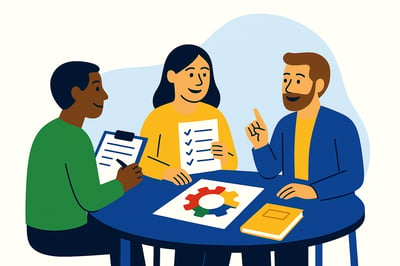
A diverse group of consultants sit around a table reviewing toolkit materials, including a checklist and a four-quadrant MyHardWired gear diagram in the correct color order—red top-left, yellow top-right, green bottom-left, blue bottom-right. They collaborate and discuss how to apply the system in practice.

  1. Audit your current deliverables and circle the ones that measure behavior rather than attitude.
  2. Create one visual that makes an invisible dynamic visible, such as a simple team Mode distribution.
    In your next proposal, highlight your toolkit as a core differentiator rather than an add on.

The Quiet Lesson

  1. Do my clients have something they can use without me?
  2. Does my toolkit show, not tell, why behavior matters?
  3. Am I selling expertise or a system that sustains it?

Where the Science Meets the Story

The Consultant’s Edge guide shows how to design a toolkit that leaders adopt and teams use. It details how to link Modes to measurable outcomes, build short cycle tracking, and package assets that live inside daily work.

Get The Guide

Choose Your Next Step

For Individuals → Understand your wiring and use tools that strengthen daily impact

For Teams → Bring visibility and structure to team behavior with shared frameworks

For Consultants → Build your toolkit with the only three dimensional behavioral system that lives beyond the workshop


Get notified on new behavioral insights


Be the first to get new articles on Preferred Style, Expectations, and Instinctive Mode and practical ways to lead, coach, and hire in alignment with how people are actually wired.