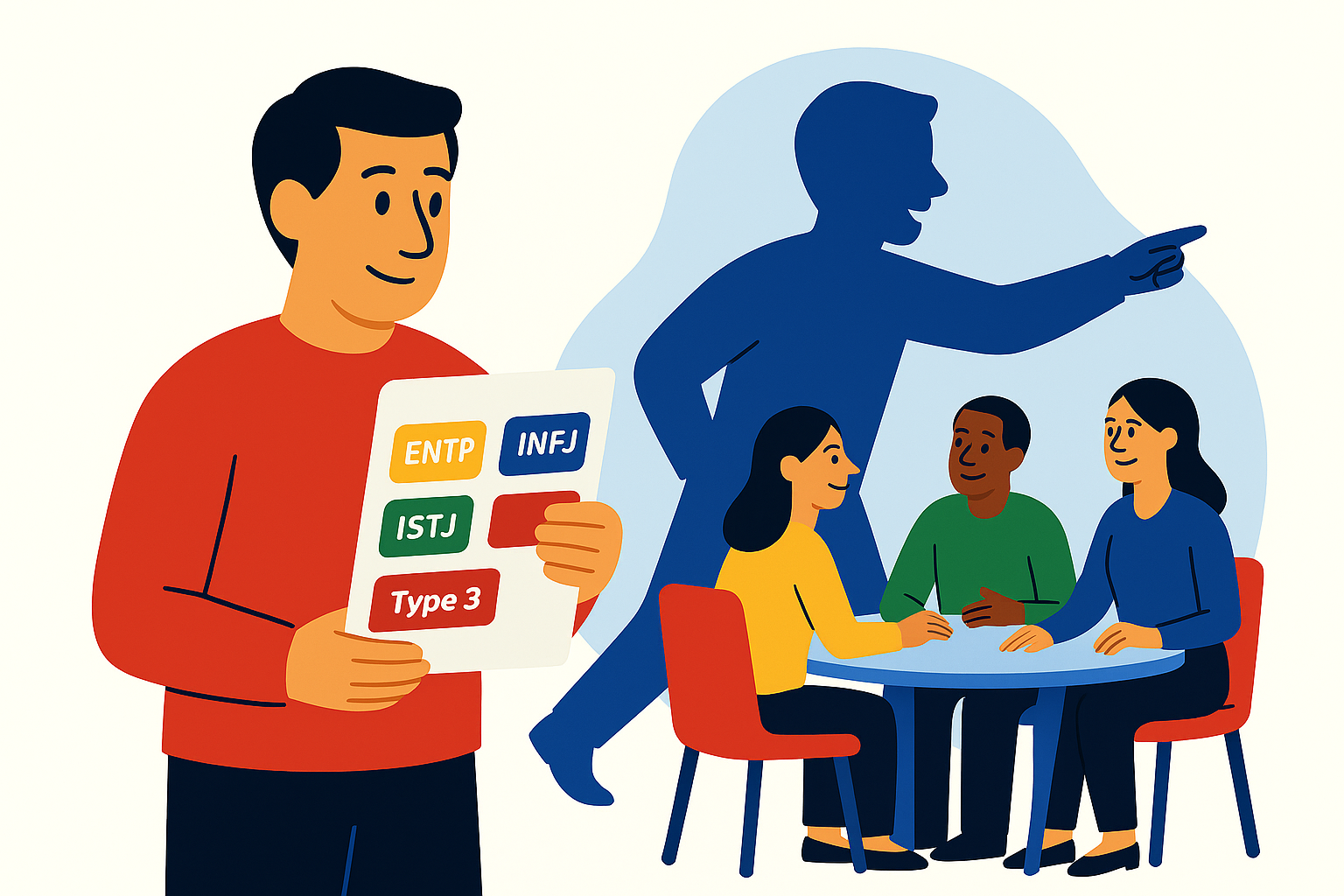
Your label might comfort you. Behavior reveals what drives results.
Labels feel safe. ENTP, INFJ, D style, Type 3. They let us lean into identity. They make self-understanding easier.
But ask any leader: leadership isn’t lived in calm, predictable conditions. When things shift, when stress shows up, teams change, or ambiguity reigns, your label rarely holds.
That’s why personality tests alone aren’t enough to predict leadership success. They describe your default state. But they don’t show how you behave when it matters.
What Personality Type Tests Do Well
Personality or type assessments are helpful when used appropriately. They:
- Reveal preferences in behavior, communication, and decision-making
- Give a shared language for teams to talk about differences
- Offer insight into general strengths and limitations
- Help people begin the work of self-awareness
For many, a label gives orientation. A place to start discovering blind spots.
Where Personality Type Falls Short
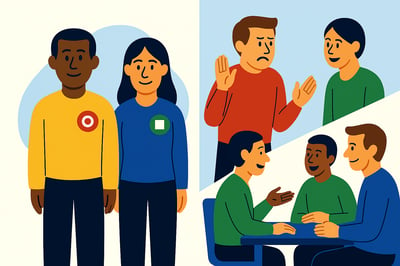
As soon as pressure, change, or complexity enters, the limits of type-based systems show up. Here’s what they often miss:
- Behavior shifts under stress
Personality types assume stable behavior. But a person who’s calm under low threat might behave very differently under high stress. Type doesn’t explain that flip.
- Context and role matter
The same person in two different roles might show different behavior. Context shapes behavior much more than labels acknowledge.
- Lack of predictive power
Many leadership outcomes (conflict handling, influence, change resilience) depend on how someone behaves when they’re stretched, not just their default mode.
- Fixed identity traps
Labels become boxes people resist growing out of: “I’m just an introvert, so I’ll never lead.” That belief stops curiosity about behavior change.
- Misalignment in subjective interpretations
Two people with the same label might approach collaboration differently. Because behavior is multi-dimensional, labels are coarse.
👉 Ever feel like your “type” boxes you in?
When Type Labels Mislead
- A leader labeled as “Type A / Red style” prides themselves on decisiveness. Under conflict, their “type” becomes a justification for being harsh, not a prompt for awareness. The team withdraws rather than argue.
- Someone seen as “highly creative, flexibility-oriented” (common Blue/Yellow type) is placed in a compliance-heavy role. When deadlines tighten, they force decisions linearly, activating stress behavior that feels out-of-character even to them.
- A person labeled “introvert” suppresses opportunity to speak up, even when their insight is needed, because the label convinces them leadership isn’t “for them.” Meanwhile, their behavior adapts when they feel safe, but the label dissuades risk.
In each case, the label obscures the deeper behavior patterns that predict how these leaders truly act under pressure.
Why Assessments with Dynamic Modes Are More Accurate
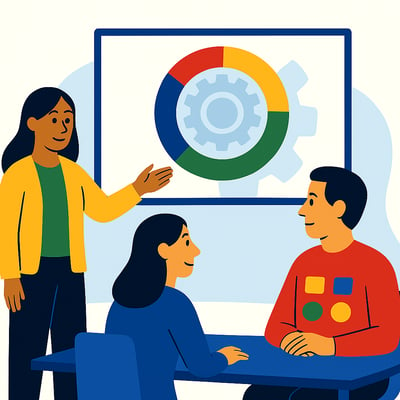
The power comes when assessments show how behavior shifts. That’s the edge that MyHardWired brings:
By modeling behavior in motion, not freeze-frame, you get insight into what actually happens when stakes rise. That predictive power is what leadership demands.
What to Ask About the Tools You Use
Before relying on any assessment (personality or behavioral), ask:
- Does it measure behavior shifts under stress or just default traits?
- What evidence supports its predictive validity (performance, leadership impact)?
- How stable are its results over time (test-retest reliability)?
- Is the logic transparent (trait weights, scoring method)?
- Can the tool guide development, not just description?
- Is it normed for leadership populations, not general populations?
If your current tools don’t pass these checks, they may produce insight but not transformation.
Quick Reflection
- Think of a time when your behavior surprised you under pressure.
- Identify how that moment differed from your “type” label's predicted behavior.
- Name which Mode you might have dropped into (Expectations, Instinctive).
- Reflect: what unmet need or trigger pushed you there?
- See how that insight changes what you do next time.
You’ll find that behavior, not label, carries the truth of your leadership.
Go Beyond Labels. Map Your Real Behavior
Your type describes your comfort zone. Your behavior map shows how you actually lead when comfort disappears.
Get The Guide
Other Roads to Explore
For Individuals → Move from self-description to self-direction and lead from behavior, not identity.
For Teams → Build trust around behavior patterns, not personality boxes.
For Consultants → Use behavior analytics to help clients translate awareness into action.