

What You’ll Learn (in 5 minutes)
By the time you skim this page (and later, the guide), you’ll be able to:
- See why most leadership programs fade by Tuesday and what’s missing
- Understand the three dimensions of leadership wiring: Preferred, Expectations, Instinctive
- Learn how wiring shapes seven essential leadership skills (communication, conflict, decisions, motivation, delegation, adaptability, vision)
- Spot real‑world patterns of “wired leadership” in action
- Get reflection questions that nudge them to notice where leadership feels natural vs. forced
Who this is for
- Executives & team leaders who want to lead without draining themselves
- HR & Talent leaders who need leadership programs that actually last
- Consultants & coaches who want a framework clients can’t unsee once they’ve experienced it
What’s Inside The Wired To Lead Guide (that’s not all on this page)
This page gives you the big picture. The guide goes further. Inside the full Wired to Lead guide, you’ll find:
-
A deeper breakdown of Preferred, Expectations, and Instinctive Modes in a leadership context
-
A chapter on each of the 7 skills, with “if you’re Green/Red/Yellow/Blue, try this” plays
-
Reflection prompts to map where your role fits your wiring and where it fights it
-
Team exercises you can drop into meetings to reset expectations and cool conflict
-
Simple templates for wired one‑on‑ones, standups, and performance conversations
Why Most Leadership Programs Fade
A lot of leadership development looks impressive and feels generic.
Many programs assume that leaders are interchangeable. Everyone receives the same list of skills, delivered in the same style, at the same pace. By the time Tuesday arrives, reality expects you to lead in your own way, not in the style of a workbook.
You may have seen this pattern.
A leader who naturally moves quickly is told to slow down and seek much more consensus. Frustration rises.
A leader who loves detail is told to think big picture and stop getting lost in specifics. Anxiety rises.
The skills are not wrong. They are simply disconnected from the wiring of the person who is asked to use them.
When development starts with behavior, your behavior, skills finally stick.
Communication lands because you use words and pacing that fit how you naturally operate.
Conflict cools because you see what is behavioral rather than personal.
Decisions speed up because you know each person’s default and you plan around it.
That is the promise of wired leadership.
Your Leadership Operating System
Under pressure, people do not become someone else. They become a more intense version of who they already are. MyHardWired describes that pattern for leaders in three modes.
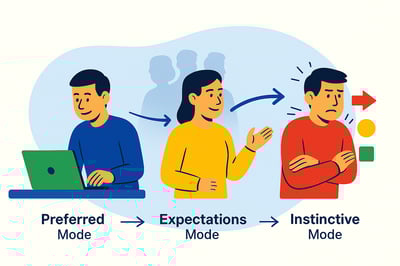
Preferred Mode
Preferred Mode is how you lead when you are at your best. It is the mix of activities and responsibilities that energize you. When your role leans into this mode, you feel present, creative, and resilient.
Preferred Mode answers questions such as:
-
What parts of leadership you look forward to
-
Which tasks leave you feeling complete rather than depleted
-
How you like to organize your time, your calendar, and your attention
Expectations Mode
Expectations Mode is how you feel people ought to behave with you and around you. It is the communication pattern you project and the pattern that keeps you listening.
It grows out of early socialization. Family, culture, and early workplaces teach you what respect sounds like and looks like. In some settings, a detailed explanation is respect. In other settings, a short direct message is respect.
Expectations Mode answers questions such as:
-
What you assume good leadership behavior looks and sounds like
-
Which approaches earn your trust and attention
-
Which tones or habits cause you to shut down or push back
Instinctive Mode
Instinctive Mode is what surfaces when pressure spikes. It describes what you need in order to feel secure enough to lead well. It drives how you react when you do not have time to think everything through.
Instinctive Mode answers questions such as:
-
How you respond when a true crisis hits
-
What you need in order to settle and refocus
-
What makes you feel safe enough to delegate and to trust others
You move among these three modes throughout the day. You cruise in Preferred Mode. You shift to Expectations Mode when your normal way of working is blocked. You fall into Instinctive Mode when the stakes feel high and time feels short.
Leadership alignment is not about living in Preferred Mode all the time. It is about moving through these three modes without breaking trust.
The Four Colors of Leadership Behavior

To make these modes easier to see, MyHardWired uses four Colors always in this order: Green, Red, Yellow, Blue.
Green leans toward structure, precision, and reliability. Green leadership cares about clarity. Green leaders want processes that work and records that prove it.
Red leans toward movement, decisions, and results. Red leadership cares about progress. Red leaders want to see things move from idea to reality.
Yellow leans toward connection, energy, and engagement. Yellow leadership cares about morale. Yellow leaders want people to feel included and motivated.
Blue leans toward ideas, depth, and meaning. Blue leadership cares about understanding. Blue leaders want to know why something matters and how it fits together.
Every leader has all four Colors. Some are more dominant than others. The important question is how Green, Red, Yellow, and Blue appear in your three modes.
The 7 Essential Leadership Skills Through MyHardWired
We do not throw away classic leadership skills. We connect them to wiring so they last.

Communication
Communication is not only about what you say. It is about how different people hear you.
Green ears listen for process, steps, and detail.
Red ears listen for priorities and outcomes.
Yellow ears listen for the tone of the room and their role in the story.
Blue ears listen for meaning and implications.
Once you see this, you stop asking only whether your message was clear. You start asking whether it was tuned to the mix of Green, Red, Yellow, and Blue in the room.
Conflict
Many conflicts in teams are patterns of wiring colliding.
Green wants accuracy and predictability.
Red wants speed and forward motion.
Yellow wants harmony and involvement.
Blue wants depth and thoughtful change.
When leaders see conflict as a clash of needs and instincts, they can lower the emotional temperature. The person across the table stops looking like a problem and starts looking like a different operating system that needs a different approach.
Decisions
Your wiring shapes your default way of making decisions.
Green leaders want to gather enough information, check the plan, and protect against risk.
Red leaders want to act, learn, and adjust in motion.
Yellow leaders want to involve the group and read the energy.
Blue leaders want to question assumptions and explore long term impact.
Healthy decision making does not require everyone to behave the same way. It invites Green to check the risks, Red to point at the target, Yellow to bring the right voices into the room, and Blue to test the deeper logic.
Motivation
Leaders often project their own motivators onto everyone else.
Green finds motivation in stability, order, and competence.
Red finds motivation in visible progress and challenge.
Yellow finds motivation in recognition and shared wins.
Blue finds motivation in purpose and learning.
If a leader only celebrates quick wins, Green may still feel unseen. If a leader only tightens processes, Yellow may feel ignored. Wired motivation means asking what each person finds energizing and giving recognition in that language.
Delegation
Delegation falls apart when leaders hand off fog instead of real responsibility.
Green wants clear scope, steps, and quality standards.
Red wants authority to act within a clear finish line.
Yellow wants to know who is involved and how success will be shared.
Blue wants to understand why the work matters and how it fits into the bigger picture.
Effective delegation combines a simple outcome statement with the specific detail, freedom, connection, or meaning that each person needs in order to own the task.
Adaptability
Change reveals the instincts of a team.
Green will try to create structure and predictability as the change rolls through.
Red will push for visible actions and results.
Yellow will work to keep people engaged and hopeful.
Blue will question and reflect so that the change has a clear purpose.
Instead of fighting these responses, wired leaders plan for them. They give Green space to build structure, Red space to move, Yellow space to rally, and Blue space to ask and answer important questions.
Vision
When leaders talk about vision, they often assume everyone is picturing the same thing. They are not.
Green pictures the systems and processes that will need to exist.
Red pictures outcomes and targets.
Yellow pictures opportunities and people.
Blue pictures new ideas and patterns of meaning.
A vision that only appeals to one Color will feel thin to the others. Wired vision invites input from Green, Red, Yellow, and Blue so that the future you describe feels real and motivating to the whole team.
Wired leadership In The Wild

Concepts matter. What matters even more is what happens on an ordinary afternoon when deadlines and emotions are both in the room.
Consider a manufacturing team on a night shift. A Red supervisor loves short direct instructions. A Green maintenance lead needs sequence and detail. When they agree that the supervisor will give a headline first and then a brief checklist, throughput improves and tempers cool.
Consider a remote nonprofit team. Slack suddenly becomes quiet. Yellow team members feel rejected. Green team members feel relieved to have space. The director names a simple norm. Silence means focused work time for the next hour followed by a clear window for questions. Anxiety drops. Productivity rises.
These are small moves rooted in wiring. They do not require a complete reinvention of the culture. They require a leader who can see behavior and respond with intention.
Frequently Asked Questions
1. Is This Just Another Leadership Personality Idea
No. Wired To Lead focuses on observable behavior at work. It uses Preferred Mode, Expectations Mode, and Instinctive Mode to describe how you actually lead, not an abstract personality label.
2. Do I Need To Be A Senior Executive For This To Matter
No. These ideas apply to anyone who leads people. That includes supervisors, managers, directors, senior executives, and people who are preparing to step into leadership roles.
3. How Does This Relate To The MyHardWired Assessment
The Wired To Lead content is the continuation of the MyHardWired model tied directly to leadership skills. The MyHardWired assessment shows your mix of Green, Red, Yellow, and Blue in each mode. This pillar explains what that means for how you communicate, decide, and navigate conflict.
4. Can This Work Alongside Our Existing Leadership Program
Yes. Treat MyHardWired as the foundational blueprint that facilitates any leadership content you already use. When people understand their own behavior and needs, other tools and frameworks have a better chance of sticking.
Is This Relevant For Remote And Hybrid Teams
Yes. Remote work amplifies misunderstandings around speed, silence, and tone. Seeing the Green, Red, Yellow, and Blue patterns in your team makes it easier to create communication norms that everyone understands.
What Should I Do After I Understand My Wiring
Start small. Choose one relationship and one skill, for example delegation with a specific team member. Apply what you know about their Green, Red, Yellow, and Blue patterns for two weeks and notice what changes.
What To Do Next
Most leaders don’t need more willpower. They need a clearer relationship with their wiring. Use this page to learn the model. Use the guide to
-
Map your own leadership wiring in more detail
-
Work through reflection prompts that reveal where your role fits you and where it fights you
-
Plan one concrete change in how you communicate, delegate, or decide over the next week
When you stop leading like someone else and start leading the way you’re wired, the work changes and so do your days.

How Behavioral Assessments Enhance Self‑Awareness for Personal Growth
Knowing who you are under pressure is the heart of real growth.
You’ve likely taken personality...

Why Traditional Leadership Metrics Don’t Measure What Matters
Most organizations measure leadership success through numbers like retention rates, productivity,...

Behavior Visibility: How Seeing What’s Hidden Raises Team Performance
Every team has two versions of itself. The one you see with roles, titles, and meetings. And the...