Results get attention. Behavior earns belief.
Every consultant knows stories sell. Not every story sticks. Most case studies sound the same. We helped the team communicate better.
Engagement improved by twenty percent. Familiar. Measurable. Forgettable.
What people remember is not the metric. It is the moment they recognize themselves. When your stories reveal behavior, not just outcomes, they stop being examples and become mirrors.
👉 Want your stories to stop skepticism and start belief. Tell behavior led stories
Why Outcomes Alone Do Not Persuade
Executives hear outcomes all day. Engagement improved. Communication increased. Retention stabilized. Those are results, not reasons. They answer what happened, but not why it worked.
Behavioral storytelling closes the gap. It connects the surface result to the human pattern beneath it. The wiring shift that made the result possible. When you show how behavior changed, you prove the change is repeatable.
What Behavior Led Storytelling Sounds Like
A traditional testimonial says this. After the workshop, our meetings were shorter and more effective.
A behavior led story says this. Before the workshop, our team’s Red urgency and Green structure kept colliding between decisions and details. Once we saw it, we designed meetings that gave space for both. Our conversations sped up because everyone finally knew what each other needed.
The first tells a result. The second shows the behavior that created it. That is what clients believe.
The Four Elements Of A Behavior Based Story
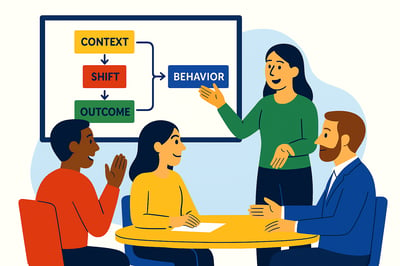
Use this simple sequence to make stories memorable and defensible.
- Context. The before
Describe the behavioral tension, not only the problem. The team lived in reactivity. Decisions were fast. Follow through lagged.
- Diagnosis. The wiring
Reveal the Mode or Color dynamic at play. MyHardWired profiles showed Red urgency dominated while Green structure and Blue analysis were undervalued.
- Shift. The intervention
Show how awareness changed interaction. We balanced the agenda for each Mode. Fast calls for Reds. Process checks for Greens. Reflection time for Blues. Recognition moments for Yellows.
- Outcome. The after
Anchor the result to the new behavior. Meetings that used to drag now end early because alignment happens faster.
Behavior based stories reveal cause and effect. That is what proves value.
How To Source Authentic stories
You do not need dramatic transformations. You need accurate behavioral insight.
Ask for permission, not perfection. Frame stories as shared learning, not advertising.
Use composite scenarios where needed. Blend similar cases to protect confidentiality while keeping truth intact.
Focus on observable shifts. Describe actions. Planning changed. Handoffs tightened. Recovery from conflict shortened.
Credit the client. Show that the framework made change possible and the client made it real.
Authenticity builds credibility. In consulting, credibility drives every sale.
Why Behavior Led Stories Convert Better
They demonstrate three things at once.
Insight. You understand what drives performance, not just what follows it.
Predictability. You can explain why results repeat.
Sustainability. You prove behavior outlasts events.
Prospects do not just think that was a good outcome. They think that could be us. That is when your story becomes a sales tool without sounding like one.
Where To Use These Stories
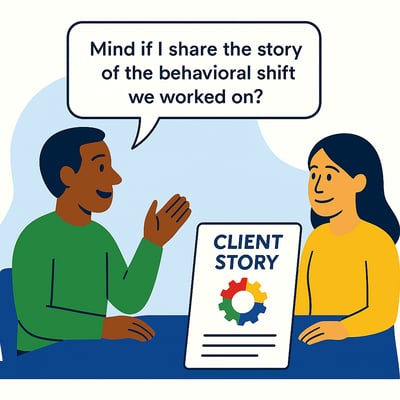
- Place one behavior based story in your next proposal so buyers see wiring, not just wins.
- Add a short behavior shift section to your case library so cause and effect is always explicit.
- Open workshops with a wiring narrative that mirrors the audience’s daily tension. The room leans in when they feel seen.
👉 Want a repeatable way to frame client stories around behavior. See the framework
Reflection For You
- Do my stories show the wiring behind the result?
- Do clients understand why the change lasted or only that it happened?
- Where can I make behavior the bridge between credibility and connection?
Why the Guide Matters
Behavioral storytelling turns case studies into proof. This guide shows how to map Context to Wiring to Shift to Outcome so your stories teach pattern recognition and demonstrate repeatability executives can trust.
Get The Guide
Choose Your Next Step
For Individuals → Understand your wiring and see what truly drives your own transformation
For Teams → Build case studies rooted in behavioral clarity and sustainable change
For Consultants → Turn client stories into proof of your framework, not just testimonials