Most teams treat conflict like a fire to put out. But what if it’s actually a dashboard to read?
Conflict isn’t proof of dysfunction. It’s data.
It shows you where expectations clash, behaviors collide, and stress signals flare.
When leaders decode those patterns instead of avoiding them, they turn tension into intelligence.
👉 Ever wish you could see conflict before it explodes? It's easy with MyHardWired
Why Teams Fear Conflict
Avoiding conflict feels safe in the moment, but it costs more in the long run.
When tension gets buried, it reappears as:
- Passive resistance (“I’ll just do it my way.”)
- Silent disengagement (“It’s not worth bringing up.”)
- Repeat blowups over the same issue.
What teams call “personality clashes” are usually behavior clashes: pace vs. precision, directness vs. diplomacy, rules vs. flexibility.
The key isn’t eliminating conflict. It’s learning to read it.
The Conflict Loop
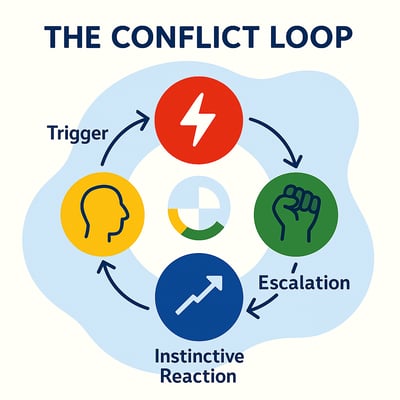
Every workplace conflict follows the same four-step loop:
1. Trigger: A decision is delayed, a deadline moves, a tone sounds off.
2. Interpretation: Each person filters the moment through their Expectations Mode or what they believe “good teamwork” should look like.
“If you respected me, you’d give details.”
“If you trusted me, you’d decide faster.”
“If you cared, you’d include people.”
3. Instinctive Reaction: When stress hits, Instinctive Mode takes over: control, push, appease, or withdraw.
4. Escalation: Now the argument isn’t about the trigger. It’s about how each person reacted to being triggered. The cycle repeats until someone learns to decode it.
When you can spot where you are in the loop, you can stop reacting and start resetting.
The Four Conflict Archetypes (and What They Need)
The Rule Enforcer: needs structure and proof.
Signals: “We’re skipping steps!” “Show me the data.”
Leader micro-script: “You own the control point. What’s the single safeguard we must keep?”
The Urgency Driver: needs momentum and ownership.
Signals: “We’re wasting time.” “Just decide already.”
Leader micro-script: “You’ve got authority on this call. Move it forward and we’ll check progress tomorrow.”
The Harmonizer: needs tone safety and inclusion.
Signals: “Let’s stay positive.” “We should hear everyone.”
Leader micro-script: “We’ll keep tone respectful. You focus on engagement, and we’ll handle the tension offline.”
The Challenger: needs logic and clarity of purpose.
Signals: “What’s the rationale?” “Why this, not that?”
Leader micro-script: “Pressure-test the top risk for five minutes, then we’ll decide.”
These archetypes aren’t labels. They’re predictable patterns. When leaders recognize them, they can respond with precision instead of frustration.
👉 Learn how behavior predicts stress responses
Tools That Turn Tension Into Insight
The Traffic-Light Agreement
- Green (Go): Behaviors that keep dialogue safe (“Summarize before you respond.”).
- Red (Stop): Words or tones that instantly shut people down.
-
Yellow (Caution): Phrases that signal rising tension (“We’re looping again.”).
-
Blue (Reflect): Space to slow thinking, invite questions, or process meaning before acting. (“Let’s pause and capture what we’ve learned.”)
The 10-Minute Conflict Decode
In the heat of the moment, pause and ask:
- What triggered this?
- What expectation did each person bring?
- What instinctive need is showing up?
- What balanced move will meet both needs?
Archetype Identification
Post the four archetypes on your team wall or digital board. When tension rises, name it:
“Feels like a Red-Green clash? Speed vs. Structure.”
It depersonalizes the conflict and resets the tone instantly.
The Shift: From Avoidance to Awareness
When you treat conflict as data, three things happen:
✔️ Conversations get shorter: you stop circling the same issue.
✔️ Emotions cool faster: people feel seen instead of blamed.
✔️ Trust strengthens: transparency replaces assumption.
Leaders who decode tension build cultures that adapt under pressure instead of fracturing under it.
Insight Check
Ask yourself before your next tough conversation:
- What kind of conflict do I avoid? Pace, Tone, or Detail?
- Which archetype do I slide into when pressure spikes?
- How do I react when others show theirs?
- What’s one behavior I could change to turn conflict into insight instead of friction?
Conflict isn’t random. It’s rhythmic.
When you learn the pattern, you can redirect it.
Unlock the Full Guide
You’ve decoded tension; now master alignment. Download the complete guide for practical frameworks that keep teams connected under pressure.
Get The Guide
Other Paths You Can Take
For Individuals → Build confidence by aligning leadership skills to your actual wiring
For Teams → Turn recurring tension into repeatable process that builds trust
For Consultants → Integrate conflict data into your coaching toolkit so you can help leaders transform tension into measurable progress