Wired To Work
Empowering Team Roles: Matching Work to Behavior, Not Assumption
Great teams don’t assign roles by seniority. They assign by behavior and flow.
Meetings don’t fail because people don’t try. They fail when behavior mismatches run the room.
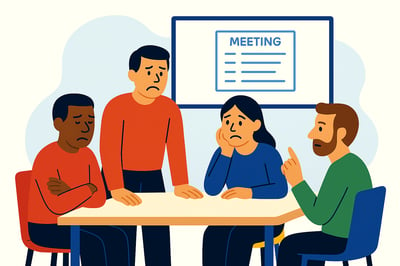
If your meetings keep circling the same topics with the same frustrations, it’s not a calendar problem. It’s a behavior problem.
Meetings don’t fail because people don’t care.
They fail when different wiring patterns run the room, and no one knows it.
👉 Next meeting feel like déjà vu? Discover how to lead your team meetings better →
Most teams run meetings like they’re one-size-fits-all: same agenda, same tone, same structure. But people don’t process, decide, or communicate the same way.
What feels efficient to one person can feel rushed to another. What feels thorough to one can feel painfully slow to others.
These mismatches drain energy. Not because of poor planning, but because of behavioral friction.
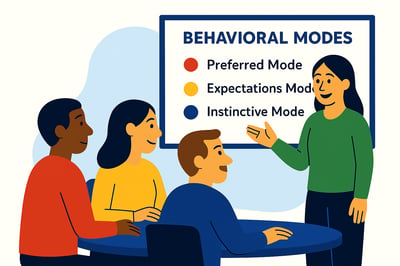
Each person brings three behavioral modes into every meeting:
When leaders ignore these dynamics, meetings stall not from lack of talent, but from predictable behavioral mismatches.
Reds want decisions now. Greens want a clear process first. The Red hears delay as inefficiency; the Green hears urgency as chaos. Without balance, both disengage. One out of frustration, the other out of fear of mistakes.
Fix: Split the meeting flow: Start with decisions (Red) and close with process validation (Green). Everyone gets what they need.
Yellows talk to think. Blues think before they talk. Yellows dominate airtime. Blues leave with unspoken insights. The group assumes “everyone’s aligned,” when the quietest person is often the one still processing.
Fix: Build “quiet time” into the meeting: Give 3 minutes of silence after each major point.
That’s when the best Blue and Green insights surface.
Fix: Name the loop in real time: “We’re in a detail-vs-decision loop.” Then assign next steps by wiring: Red decides, Yellow summarizes and shares, Blue pressure-tests, Green validates process.
You can predict and prevent meeting dysfunction by making wiring visible.
In your next meeting, note who:
Energy gaps reveal misalignment.
A balanced meeting touches all four:
|
Color |
What They Need |
Meeting Segment |
|
Green |
Detail, certainty |
Middle: process & next steps |
|
Red |
Urgency, clarity |
Kickoff: purpose & decisions |
|
Yellow |
Connection, tone |
Collaboration & updates |
|
Blue |
Meaning, reflection |
Wrap-up & implications |
If one color dominates, others mentally check out.
When stress spikes, behaviors change fast.
Greens defend the plan.
Reds push harder.
Yellows smooth tension.
Blues withdraw to think.
Recognizing these patterns lets you redirect the conversation before it derails.
👉 Learn how MyHardWired maps stress behavior
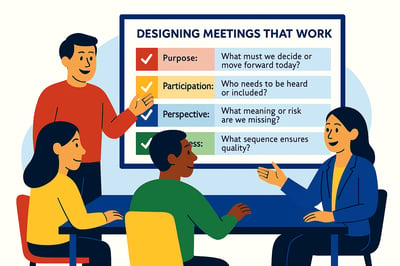
Use these behavioral anchors to keep energy balanced:
✔️ Purpose (Red): “What must we decide or move forward today?”
✔️ Participation (Yellow): “Who needs to be heard or included?”
✔️ Perspective (Blue): “What meaning or risk are we missing?”
✔️ Process (Green): “What sequence ensures quality?”
Meetings that hit all four don’t just run smoother. They retain energy afterward.
Before your next session, ask:
Your meetings aren’t broken. They’re broadcasting data.
You just need to listen behaviorally.
Meetings are just one expression of team wiring. Get the complete framework for communication, conflict, and collaboration.
For Individuals → Learn how to shift from reaction to response in every conversation
For Teams → Design structures that honor every communication style
For Consultants → Expand your toolkit with data-driven behavioral insights
Great teams don’t assign roles by seniority. They assign by behavior and flow.
Hacks don’t fail. Misalignment does. Choose methods made for you.
Discover how feedback culture fails without behavioral understanding and learn strategies to make feedback truly effective for your team.
Be the first to get new articles on Preferred Style, Expectations, and Instinctive Mode and practical ways to lead, coach, and hire in alignment with how people are actually wired.