Wired To Work
Collaboration Friction: When Natural Strengths Collide
Teams get stuck when strengths collide unknowingly. Recognizing behaviors turns strength into harmony.
Change shakes us. Clarity steadies. Awareness makes transitions doable.

Change is inevitable. It interrupts routines, challenges expectations, and exposes stress points.
Whether it is a role shift, a team restructure, a new strategy, or a personal life transition, change tests your ability to adapt.
For most people, the difficulty is not the change itself. It is how behavioral wiring responds under pressure.
Self-awareness turns change from something destabilizing into something navigable.
See how MyHardWired reveals your unique wiring
Change disrupts familiar patterns and pushes people outside their natural comfort zones. It forces the brain to operate in ways that may not come easily, revealing stress points that would otherwise stay hidden.
These reactions are not flaws. They are behavioral signals like data points that tell you where your focus and support are needed most.

Transitions fail not because of change itself, but because they are managed without awareness.
Here’s what that looks like in practice:
Leaders assign rapid, ambiguous projects to people who need structure and clarity. Collaborative personalities are asked to work in isolation.
Decisive people are placed in long planning phases with no action outlet. Reflective thinkers are rushed through complex adjustments with no time to process.
When change management ignores wiring, resistance grows, not from negativity, but from behavioral misfit. The work becomes harder than it has to be.
Self-awareness doesn’t eliminate uncertainty. It gives you stability within it.
And above all, communicate your needs early. Transparency builds trust during transition. When you work in sync with your wiring, energy returns. Fatigue turns into focus.
Change always reveals who you are beneath routine. It shows where confidence comes from and where uncertainty hides. The goal isn’t to avoid change, but it’s to meet it as someone who understands their own behavioral map.
When you know what drives your reactions, you move through uncertainty with calm conviction. Change stops feeling like something happening to you. It becomes something happening through you.
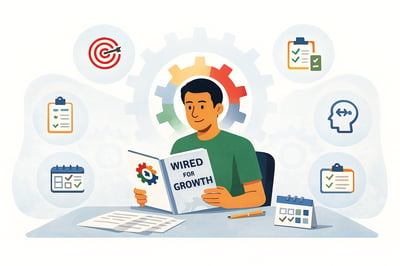
The Wired for Growth guide helps you understand how your behavioral modes shape reactions during transition. It reveals how to build stabilizing routines that match your wiring and how to design clarity when everything else shifts.
For Individuals → Stop letting change catch you off guard. Use your wiring to create behavioral anchors that keep you steady through transition
For Teams → Design change strategies that respect behavioral differences. Keep communication clear, energy aligned, and resilience high
For Consultants → Help clients navigate transitions strategically. Use behavioral insights to guide them through change with confidence
Teams get stuck when strengths collide unknowingly. Recognizing behaviors turns strength into harmony.
Discover how to manage communication clashes between speed and detail, and align your team's diverse styles for better collaboration and...
Different functions bring different behaviors. Understanding conflict styles saves collaboration.
Be the first to get new articles on Preferred Style, Expectations, and Instinctive Mode and practical ways to lead, coach, and hire in alignment with how people are actually wired.